Web3 Security Breach Analysis H1 2026: Key Exploits, Vulnerabilities & Lessons Learned
Exploring real-world Web3 breaches from H1 2026 to highlight patterns, security gaps, and lessons for building safer decentralized systems. An in-depth analysis by 0xTeam.
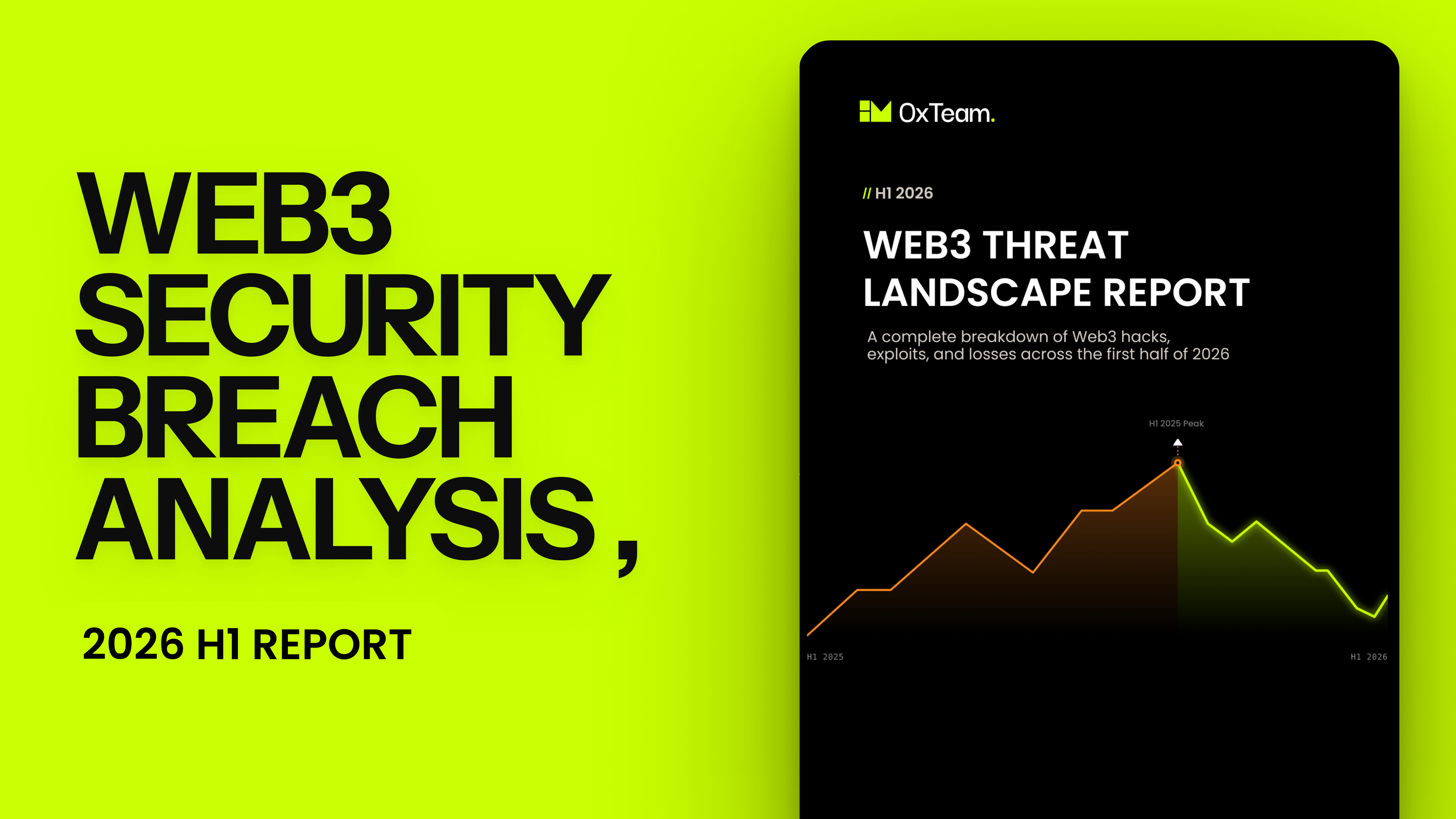
The Web3 threat landscape in H1 2026 tells a deceptive story: total losses dropped sharply from the year before, even as the number of attacks hit a record high.
Attackers spread across a wider surface, leaned harder on infrastructure and private key compromises, and reserved state-backed operations for the biggest paydays — a shift felt across DeFi, CeFi, and AI-integrated platforms alike.
0xTeam's 2026 Mid-Year Web3 Security Report is now out, providing a detailed look at the hacks, scams, vulnerabilities, and overall security trends from the first half of 2026.
Our research shows around $972 million was lost across a record 207 incidents, underscoring that a lower dollar total does not mean a safer ecosystem.
Key Insights from H1 2026 Web3 Security:
- 1. ~$972 million was lost across a record 207 hacks, exploits, and scams — the highest incident count for any six-month window.
- 2. Infrastructure and private key compromises drove roughly 76% of all losses despite representing only about 15% of incidents.
- 3. North Korea-linked groups accounted for approximately $643 million — around 66% of all stolen funds in H1.
- 4. Wallet and key compromises were the single most expensive vector, with $444.5 million lost across 33 incidents.
- 5. Phishing caused $366.3 million across 63 incidents — fewer attacks than last year, aimed at higher-value victims.
- 6. Smart contract exploits were the most frequent category, at 125 of 207 incidents (60%), but smaller per hit — totaling around $151.6 million.
- 7. Continuous security audits, live monitoring, infrastructure hardening, and key governance are critical to detecting and mitigating these evolving risks.
Web3 Security Breach Analysis H1 2026: Top Security Incidents
The largest incidents of H1 2026 were dominated by infrastructure and key compromises rather than smart contract bugs:
- Drift Protocol — ~$285–295M (April, Solana). Admin key / governance compromise; the largest single hack of the half.
- KelpDAO — ~$292M (April, Ethereum / Arbitrum). Bridge compromise and fake collateral that triggered a multi-billion-dollar bank run on Aave.
- Humanity Protocol — ~$36M (June, Ethereum / BNB Chain). Phishing → malware → private key theft from a single laptop holding three multisig keys.
- Step Finance — ~$27–30M (January, Solana). Executive device compromise giving access to multisig signing infrastructure.
- Rhea Finance — ~$18.4M (April, NEAR). Slippage-logic flaw combined with oracle manipulation across hundreds of fake wallets and pools.
A full incident-by-incident breakdown, including attack flows and recovery outcomes, is available in the downloadable report above.
Web3 Security Breach Analysis H1 2026: Losses by Chains
Ethereum remained the most-targeted chain in H1 2026, absorbing the largest share of losses by both incident count and dollar value — its deep liquidity is always the deepest target. A full chain-by-chain breakdown is available in the downloadable report above.
Don't launch vulnerable code. Our team will review your smart contracts and deliver a full audit report within 48 hours.